Weighted Blankets and Children: The Safety Rules
Weighted blankets are not safe for babies under one, and NHS guidance says children should not sleep under one overnight. The rules that matter.
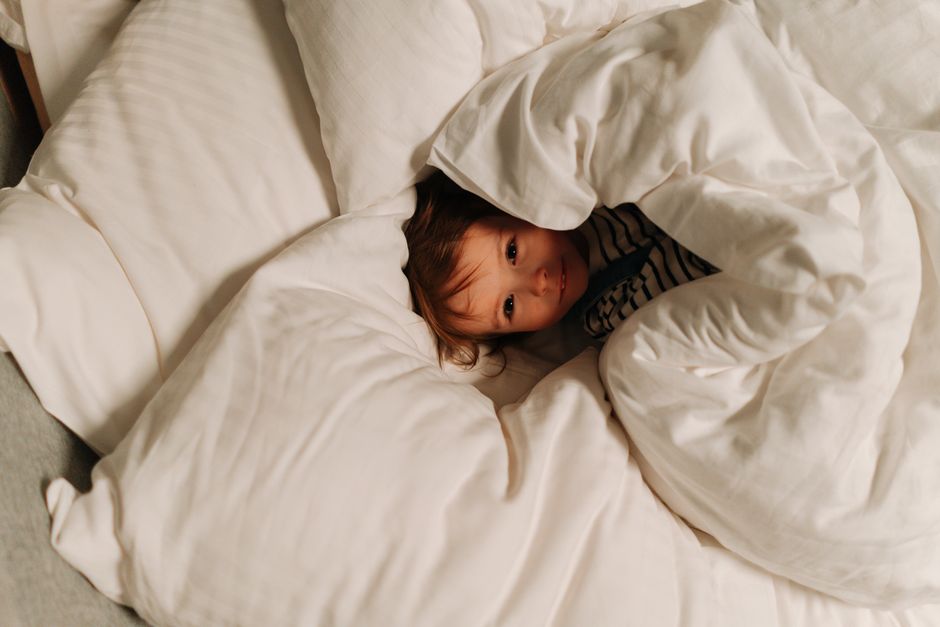
Weighted blankets are sold as a sleep aid for children, but the published safety guidance is narrower than the marketing. Two rules do most of the work: nothing weighted goes near a baby under one, and an older child must always be able to get out from under the blanket without help.
The guidance below comes from The Lullaby Trust (the UK charity that sets safer-sleep advice for babies), the Royal College of Occupational Therapists (RCOT, the professional body for OTs in the UK) and NHS children's therapy services, plus product-safety regulators. Where those bodies disagree with how these blankets are marketed, this guide follows the guidance.
Can a baby use a weighted blanket?
No. The Lullaby Trust states plainly that weighted swaddles, blankets and sleeping bags are not recommended for babies under one year, citing a risk of overheating and head covering, and noting that they can restrict breathing by pressing on a baby's chest.
Regulators outside the UK reached the same position. In an April 2024 statement, the US Consumer Product Safety Commission (CPSC, the federal regulator for consumer product safety) warned against weighted blankets and weighted swaddles for infants, and recorded that there have been multiple infant deaths in these products. The Centers for Disease Control and Prevention is quoted in the same statement as saying weighted sleepers, swaddles, sleep sacks and blankets are not safe for infants.
The mechanism is anatomical rather than a matter of degree. Dr Rachel Moon, co-chair of the American Academy of Pediatrics task force on sudden infant death syndrome, has explained that a newborn's rib cage is not rigid, so it takes little pressure to compress it and obstruct breathing. The Academy has also pointed to evidence that weighted sleep products can lower an infant's oxygen levels, which may affect the developing brain. This is why the advice is a flat no rather than a lighter blanket.
What age can a child use a weighted blanket?
There is no single legal or clinical age threshold above one year, which is why retailers quote different minimums. Suppliers commonly set three years as a floor, on the reasoning that by then most children can push a blanket off themselves.
UK clinical services frame the question differently. Rather than an age, RCOT and NHS therapy services set a process: weighted items should be introduced after a sensory assessment by an occupational therapist with postgraduate training in sensory integration. Derbyshire Healthcare NHS Foundation Trust states this directly in its parent guidance, specifying an OT trained to at least Level 3 in sensory integration theory and practice.
That matters because the children most likely to be given a weighted blanket, autistic children and those with sensory processing differences, are also the group for whom the fit needs individual judgement. Capability, not birthday, is the real threshold. A child who cannot reliably push a heavy blanket off, or cannot communicate that they want it off, is not ready for one regardless of age.
How heavy should a child's weighted blanket be?
The rule occupational therapists use is 10% of the child's body weight plus 1lb. For a 30kg child that lands around 3.4kg. Some NHS services state the cap more conservatively as no more than 10% of body weight with no addition.
Round down rather than up, and never size up so a child can grow into it. A blanket that is correct for a 40kg teenager is not a heavy blanket for a 20kg seven-year-old, it is double the recommended load. Our weighted blanket weight guide works through the sizing maths for adults and children, including what to do when a child sits between two standard weights.
Should a child sleep under a weighted blanket all night?
This is where published guidance and product marketing part company most sharply. Weighted blankets are widely sold as an overnight sleep aid for children. NHS children's therapy services advise against exactly that.
Somerset NHS Foundation Trust's parent guidance states that the blanket must not be used overnight and should be removed once the child is asleep. Derbyshire's guidance goes further, advising that a weighted blanket can form part of a bedtime routine but should not be used while the child is in bed, and recommending no more than 20 minutes of use at a time with at least a 40-minute break, because the nervous system habituates to the sensation.
The reasoning is supervision. The safety rules for weighted blankets all depend on an adult being able to see the child, and an unsupervised sleeping child cannot be monitored for laboured breathing or a blanket that has shifted onto the chest or face. A child who genuinely settles better with deep pressure can still get that benefit in the wind-down before sleep.
Which children should not use one at all?
NHS therapy services list conditions where a weighted blanket is inadvisable without specific clinical advice. The recurring contraindications across trust guidance are:
Any baby under one year
No exceptions, at any weight.
Epilepsy
Derbyshire's guidance states weighted blankets are not recommended where a child has an epilepsy diagnosis.
Breathing or respiratory conditions
Chest loading is the core hazard, so any condition affecting breathing raises the stakes.
Cardiac or circulatory problems
Listed as a contraindication in RCOT-informed trust guidance.
Significant low muscle tone
A child with serious hypotonia may lack the strength to push the blanket off.
Difficulty regulating temperature, or skin conditions
Overheating and skin pressure are both documented risks.
Any difficulty removing it or communicating discomfort
Covers physical, learning and developmental factors. This is the rule that overrides all the others.
What actually went wrong in the recalled blankets?
The largest children's weighted blanket recall to date is worth understanding precisely, because the hazard was not the one most people assume.
In December 2022 Target recalled around 204,000 Pillowfort children's weighted blankets in the United States. The blankets weighed 6lb, well within the usual sizing rules for an older child. The hazard the CPSC recorded was entrapment: a young child could unzip the removable cover and climb inside it. A four-year-old girl and a six-year-old girl died of asphyxia after becoming entrapped in the cover in April 2022, and four entrapment reports were received in total.
So the danger was not the weight crushing a sleeping child. It was a zip, a removable cover and an unsupervised child, and a correctly weighted blanket offered no protection against it. When checking a blanket, look at how the cover fastens and whether a child could get inside it, not only at the number on the label.
The safety checklist
Child is over one year old
Non-negotiable. Nothing weighted below 12 months.
Weight is no more than 10% of body weight, plus at most 1lb
Recalculate as the child grows rather than buying ahead.
The child can push it off without help, and has been shown how
Test this while awake before it is ever used unattended.
Head and neck are never covered
The blanket covers the body from the shoulders down.
An adult can see the child throughout
Watch for laboured breathing, sweating, or a change in colour. Stop immediately if any appear.
Used in the wind-down, not slept under overnight
NHS guidance is to remove it once the child is asleep.
The cover cannot be unzipped and climbed into
The specific failure behind the 2022 Pillowfort recall.
No epilepsy, respiratory, cardiac or muscle-tone contraindication
Check with the child's clinician if any apply.
Never used as a restraint
Including to manage behaviour or keep a child in one place.
Frequently asked questions
Are weighted blankets safe for children?
What weight weighted blanket should a child have?
Can a 2-year-old use a weighted blanket?
Why do NHS services say not to use one overnight?
Do weighted blankets help autistic children sleep?
How Heavy Should a Weighted Blanket Be? UK Guide

Do Weighted Blankets Actually Help You Sleep?